Innovation is often associated with laboratories, research facilities, and groundbreaking discoveries. However, its true value lies in how knowledge and technology can be applied to solve real business challenges.
For many small and medium enterprises (SMEs), turning innovative ideas into commercially successful products requires more than ambition alone.
Access to expertise, technical knowledge, and industry support can often determine whether a business moves forward or remains stagnant.

This is where Thailand’s National Science and Technology Development Agency (NSTDA) plays an important role.
Through its Industry Innovation and Technology Assistance Programme (ITAP), the agency helps businesses adopt science, technology and innovation to improve productivity, strengthen competitiveness and unlock new growth opportunities.
Innovation is often associated with laboratories, research facilities, and groundbreaking discoveries.
However, its true value lies in how knowledge and technology can be applied to solve real business challenges.
For many small and medium enterprises (SMEs), turning innovative ideas into commercially successful products requires more than ambition alone.
Access to expertise, technical knowledge, and industry support can often determine whether a business moves forward or remains stagnant.
As Food, Agriculture and Health Industry Section Manager under ITAP, Peechaya Jirathumkitkul works closely with SMEs seeking to improve products, upgrade production processes and navigate increasingly competitive markets.
Her work focuses on helping businesses gain access to the expertise and support needed to transform ideas into practical solutions.
BUSINESS AND EXPERTISE
For more than 30 years, ITAP has served as a bridge between businesses and the research community.
Many SMEs have strong business ideas but limited access to technical expertise, while researchers often possess valuable knowledge that may not reach industry players directly.
Bringing these groups together is one of ITAP’s core functions. Through the programme, businesses are connected with specialists from NSTDA, universities, public research institutions and industry networks.
These collaborations allow companies to access expertise that can help address technical challenges, improve operations and accelerate product development.
Without a platform that facilitates these connections, collaboration can be difficult. Businesses and researchers often operate in different environments, with different priorities and communication styles.
Acting as an intermediary, ITAP helps ensure that both sides work towards common goals while maintaining a productive working relationship throughout each project.
MARKET-READY SOLUTIONS
Innovation becomes meaningful when it produces tangible results. Rather than relying on a general advisory model, ITAP adopts a project-based approach in which businesses work directly with experts to address specific challenges.
Each project is tailored to the company’s needs, ensuring that solutions remain practical and commercially relevant.
Support may involve developing new products, improving manufacturing processes, increasing production capacity or enhancing operational efficiency.
By working alongside industry experts, businesses can apply knowledge directly to their operations while gaining valuable skills that remain useful long after a project is completed.
This hands-on approach also encourages knowledge transfer. Instead of simply solving immediate problems, companies develop a stronger understanding of technology and innovation, allowing them to become more self-reliant in the future.

GROWTH THROUGH INNOVATION
Innovation often requires investment, and this can be a significant challenge for smaller businesses. To encourage greater adoption of technology, ITAP provides partial financial support for selected projects.
This support helps businesses undertake activities such as research and development, production upgrades, certification requirements and sustainability initiatives.
Beyond improving efficiency, these efforts help companies better meet increasingly demanding market expectations. International buyers are paying greater attention to quality assurance, food safety, environmental responsibility and product consistency.
Businesses that invest in these areas are often better positioned to compete both locally and internationally.
Sustainability has also become an increasingly important consideration.
As global markets place greater emphasis on environmentally responsible practices, businesses are expected to demonstrate a commitment to reducing waste, improving resource efficiency and adopting greener production methods.
GLOBAL OPPORTUNITIES
Supporting innovation is only one part of the equation. Businesses must also understand where their products fit within the global marketplace.
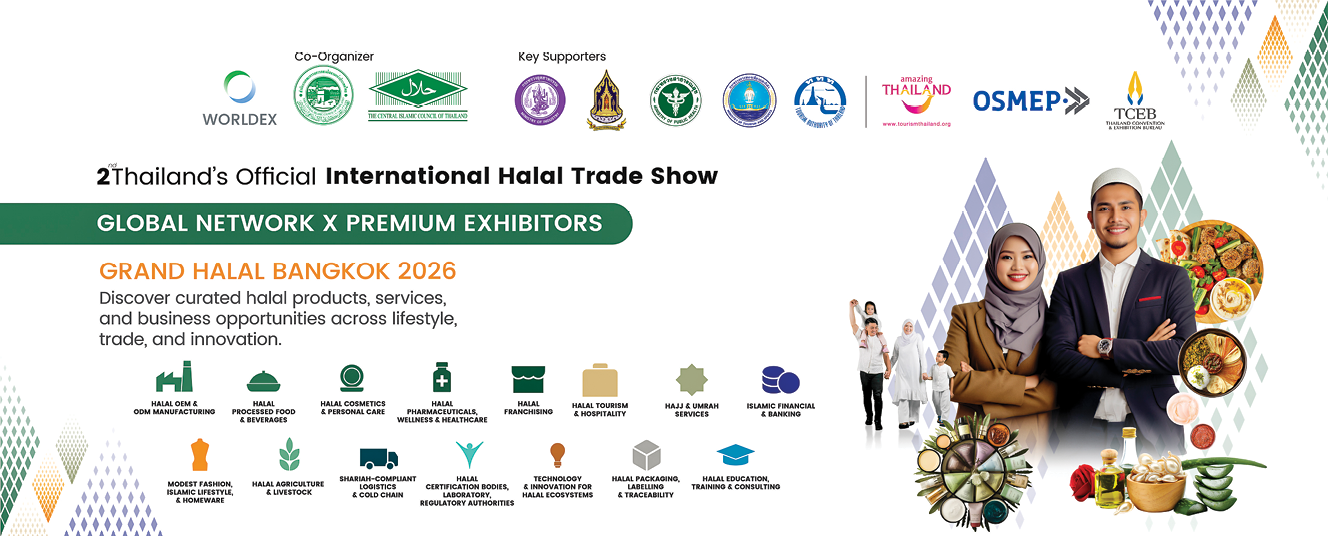
Events such as Grand Halal Bangkok 2026 provide valuable opportunities for SMEs to showcase products, connect with buyers and gain direct market feedback.
More importantly, they allow businesses to assess how well their products align with international demand.
Feedback from consumers, distributors, and industry players can reveal important insights into market expectations, product strengths, and areas for improvement.
Such information is often difficult to obtain through conventional research alone.
The event also creates opportunities for companies to establish partnerships that may support future expansion.
Building relationships with distributors and business partners can help SMEs enter new markets more effectively while reducing some of the challenges associated with international growth.

LONG-TERM COMPETITIVENESS
Many businesses begin their journey through OEM or private-label manufacturing. These models provide a practical entry point, allowing entrepreneurs to test products and gain market experience with relatively lower risk.
However, long-term competitiveness depends on more than manufacturing capabilities alone. Developing original products, strengthening innovation capacity and building unique market offerings are essential for sustainable growth.
Businesses that invest in research and product development are often better positioned to differentiate themselves in increasingly competitive industries.
Thailand’s strengths in agriculture, food production and research provide a strong foundation for this transformation.
By combining local resources with innovation and technology, businesses can create products that offer greater value while addressing evolving consumer needs.