“Gelatin is a critical substance for halal compliance since it is derived from animal collagen. If the animals were not slaughtered according to the shari’ah law, the gelatin is non-halal, making the juice haram (forbidden) regardless of its final clarity.”
Stroll through any supermarket, and you will find shelves packed with colourful packages, promising convenience and flavour at the twist of a cap or the tear of a wrapper. From instant noodles to frozen prawn sambal, these products are designed to make our lives easier and our meals quicker to prepare.
While many of us glance at labels to check for sugar content or calorie count, there is a hidden world behind the listed ingredients that remains largely unseen: the processing aids. Imagine these processing aids as the unsung heroes of food production, performing essential tasks like stabilising flavours, preserving textures, and ensuring the consistency of products.

International Institute for Halal Research and Training (INHART), International Islamic University Malaysia (IIUM)
Unlike additives, which are clearly labelled, processing aids are not required to be listed on the packaging.
This invisible presence raises a significant question for millions of Muslim consumers: Are these unseen “ingredients” halal? For Muslims, the food’s journey from farm to table is just as important as the final product.
Transparency is key, but it is often elusive in processed foods. Some additives are cloaked under generic terms like “spices”, making it nearly impossible to discern their exact origins. This opacity extends to processing aids, making it difficult for consumers to make informed choices.
UNDERSTANDING PROCESSING AIDS
According to Regulation 19A, Malaysia Food Regulations 1985, processing aids means “any substance that is used in the processing of raw materials, foods or ingredients, to fulfil a technological purpose relating to treatment or processing but does not perform a technological function in the final food product and may result in an unavoidable presence of residues in the final food product”.
There are three situations in which a manufacturing substance is deemed to be a processing aid (Food Safety and Inspection Service, 2008):
• Substances that are added during the processing of a food but are removed in some manner from the food before it is packaged in its finished form;
• Substances that are added to a food during processing are converted into constituents usually present in the food and do not significantly increase the amount of the constituents naturally found in the food or
• Substances that are added to a food for their technical or functional effect in the processing but are present in the finished food at insignificant levels and do not have any technical or functional effect in that food.
Since they are not typically present in the final product or present only in negligible amounts, they are considered distinct from ingredients and additives. These processing aids help in various stages of processing, such as improving texture, appearance, or processing efficiency. They may include solvents, catalysts, lubricants, antimicrobial agents, or other chemicals. Some processing aids and their purposes are given in Table 1.
Note that all of these materials must be approved for use with foods, and their presence in the final food must be consistent with food safety. As such, these substances shall be used under conditions of good manufacturing practices (GMP) which include the following:
• the quantity of the substance used shall be limited to the lowest achievable level necessary to accomplish its desired technological function;
• residues or derivatives of the substance remaining in food should be reduced to the extent reasonably achievable and should not pose any health risk and
• the substance is prepared and handled in the same way as a food ingredient (Malaysia Food Regulations 1985).
STATUS OF PROCESSING AIDS?
Various processing aids, which are often invisible to the consumer, can complicate matters. These processing aids can leave behind residues or derivatives in the final product, raising essential questions about their halal status. Even trace amounts can be significant for halal compliance.
For instance, consider the materials used to lubricate food-processing equipment, like metal conveyor belts. If these lubricants contain animal fats such as lard (from pigs) or tallow (from non-slaughtered cows or goats), they can render a product non-halal.
Even if the amounts are tiny, their presence can compromise the halal integrity of the food. Another example is fruit juices. To clarify fruit juices, manufacturers might add materials like gelatin. Although these clarifying agents are intended to be filtered out before the final product is packaged, traces can remain.
Gelatin is a critical substance for halal compliance since it is derived from animal collagen. If the animals were not slaughtered according to the shari’ah law, the gelatin is non-halal, making the juice haram (forbidden) regardless of its final clarity.
Ensuring that processing aids and all other ingredients meet halal requirements is a meticulous and vital part of the certification process. These ingredients must be scrutinised, from the raw materials to the final product, to guarantee that halal integrity is maintained.
This rigorous oversight ensures that consumers can trust the halal label on their food, confident that every aspect of its production has been carefully vetted. This diligence aligns with the divine guidance in the Quran:
[Allah said], “O messengers, eat from the good foods and work righteousness. Indeed, I, of what you do, am Knowing.” (Quran, Al-Mu’minun, 23:51).
By ensuring that food products are halal and pure, halal certification bodies uphold the Quranic principle of consuming what is good and striving for righteousness. This commitment not only fulfills religious obligations but also builds trust and confidence among consumers, knowing that their food is produced with the utmost care and integrity.
PROCESSING AIDS IN HALAL-CERTIFIED PRODUCTS
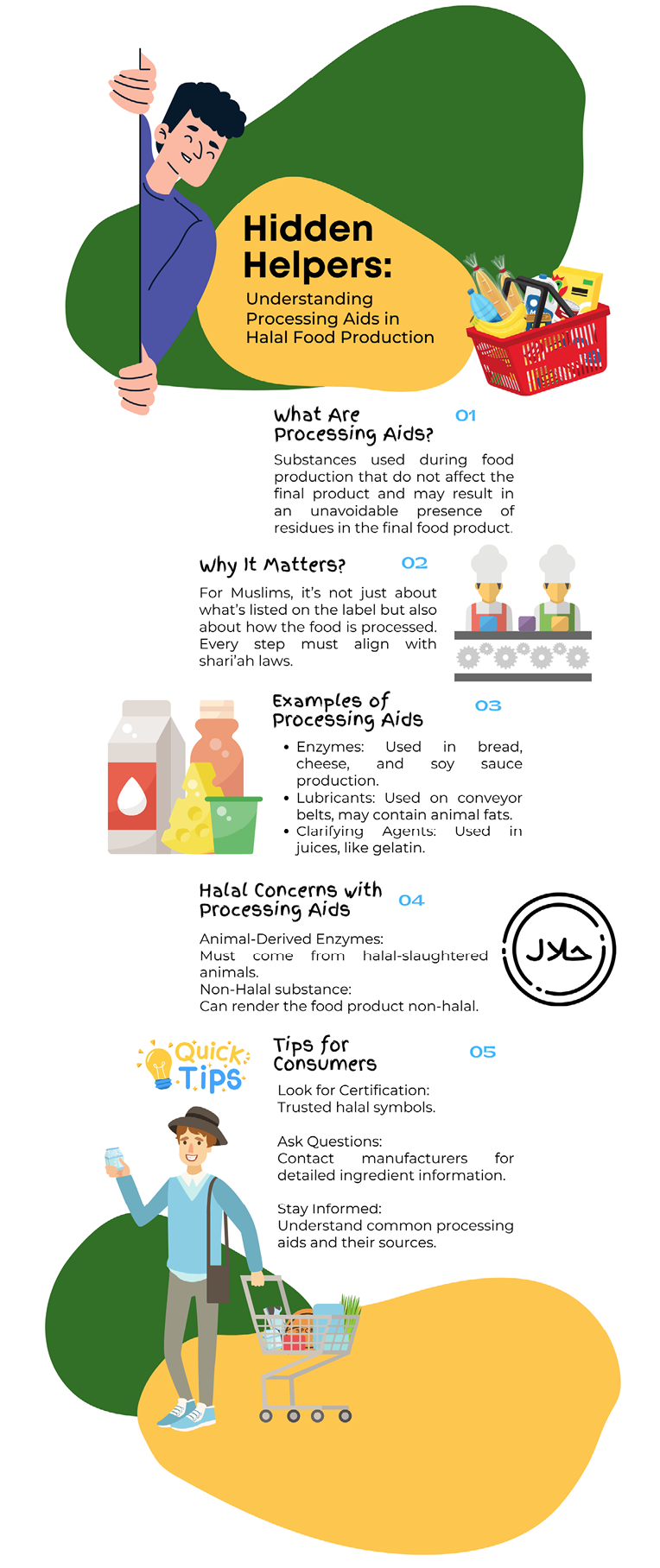
Halal certification of food products is not just about the ingredients but also the intricate processes behind the scenes. Halal certification bodies meticulously evaluate various factors, including the permissibility of ingredients and additives, as well as the methods used in food processing.
They ensure that every stage of production aligns with shari’ah and standards, guaranteeing that the products meet halal requirements comprehensively.
To reiterate, one of the key aspects scrutinised is the status of processing aids. These are substances that may not appear on the final product label but play crucial roles during production. According to the Manual Procedure for Malaysia Halal Certification (Domestic) 2020 (MPPHM, 2020), every processing aid must be confirmed as halal, safe, and uncontaminated.
This means that from the enzymes used in fermentation to the anti-foaming agents ensuring product consistency, everything must adhere to halal requirements.
Furthermore, the Malaysian Standard MS1500:2019 Halal Food – General requirement (Third revision), under clause 4.3.1, stipulates that “Devices, utensils, machines, and processing aids used for processing halal food shall be designed and constructed to facilitate cleaning and shall not be made of or contain any materials that are decreed as najs by the shari’ah and shall be used only for halal food” (MS1500:2019, 2019).
This ensures that not only the tools but also the processing aids involved in food production must come from halal materials and not contain any elements that are decreed as najs by the shari’ah.
Imagine the journey of a simple packaged snack, from the raw materials sourced to the final product on the supermarket shelf. Every step, from the mixing bowls to the packaging machines, must be free from contamination and aligned with halal principles.
By ensuring that every component, including processing aids, adheres to stringent halal standards, certification bodies provide consumers with the confidence that the products they choose are genuinely halal. So next time you pick up a halal-certified product, remember the intricate and diligent process that ensures its purity and compliance from farm to table.
CONSUMER AWARENESS AND EDUCATION
Ensuring the halal status of food products is a complex and meticulous process that extends beyond the visible ingredients listed on the packaging. Processing aids, often hidden from consumer’s view, play a crucial role in food production but can pose significant challenges to maintaining halal integrity.
While halal certification bodies work diligently to scrutinise every detail, it is equally important for consumers to be educated and vigilant about what they consume. Consumer education is vital in empowering individuals to make informed choices about halal products. Understanding the potential presence and impact of processing aids helps consumers to assess the halal integrity of their food better.
By being aware of the complexities involved in food production, consumers can ask the right questions, seek detailed information from manufacturers, and support products that adhere to stringent halal standards.