Malaysia is a multicultural nation, and its true strength lies not only in its diversity but in its unity. With Chinese New Year just around the corner, the country has a remarkable opportunity to use this celebration to attract both domestic and international tourists.

Yap Yun Hin
In Malaysia, culture and tradition unite communities, while religious differences are never a source of division. The country’s diversity makes it unique, allowing visitors to witness the harmonious coexistence of various communities, including the culture and influence of Chinese Muslims, offering a truly distinctive experience.
Malaysian Chinese Muslim Association (MACMA) President Prof. Datuk Dr Taufiq Yap Yun Hin said the organisation aimed to serve as a bridge between Muslim and non-Muslim communities in Malaysia, mainly focusing on empowering Chinese Muslims.
“We want to share the universal message of Islam with the wider Chinese community. This includes addressing any cultural or religious misunderstandings or misconceptions that may arise. This is particularly important in Malaysia because there’s often the assumption that Chinese people must be non-Muslims.
Automatically, for example, when you see Chinese characters, some might immediately think, ‘This is not halal.’ This is one of the misconceptions we frequently encounter, and we are working to address this issue,” Taufiq explained.
CHINESE MUSLIMS IN MALAYSIA
He highlighted Malaysia’s strengths as a Muslim-friendly destination, emphasising its unique position as a Muslim-majority country that offers a broad range of Islamic values and services alongside other attractions for tourists.
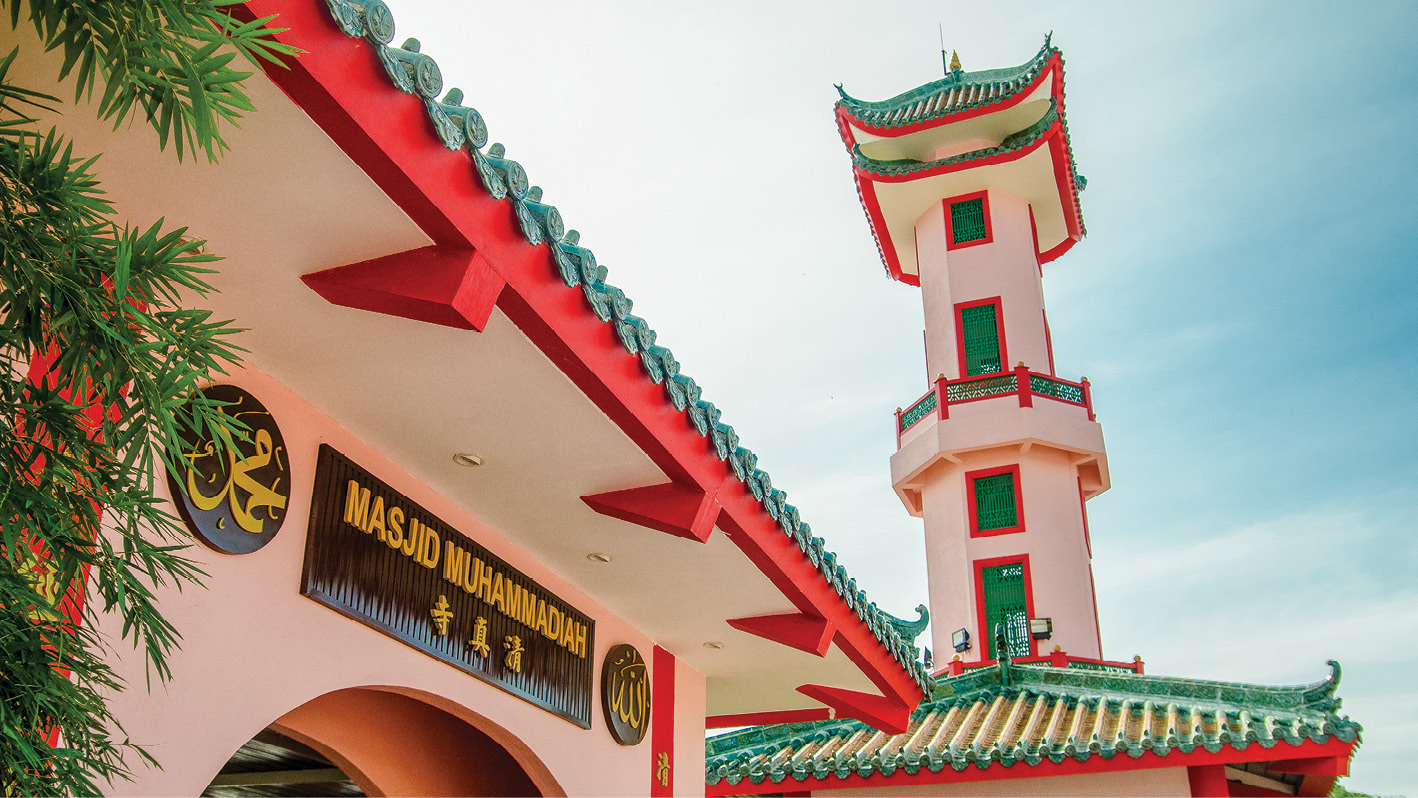
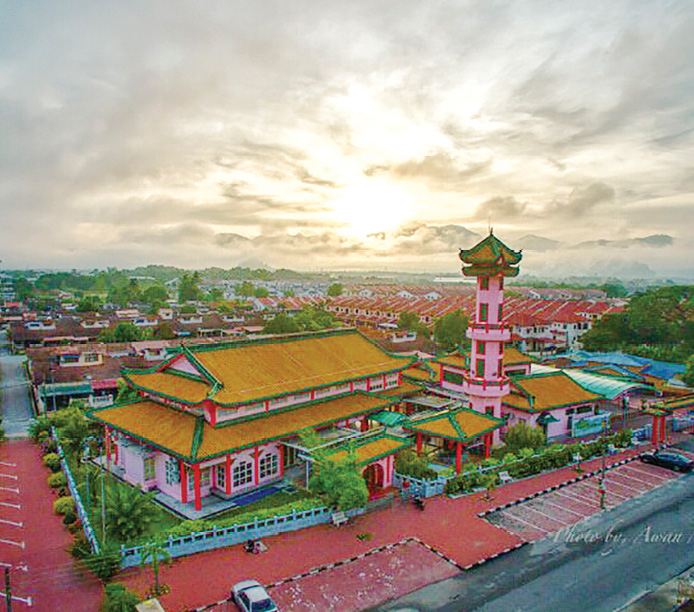
Taufiq acknowledged mosque tourism as one of the key attractions of Malaysia’s Muslim-friendly appeal. From the perspective of Chinese Muslims in Malaysia, he noted that they have the opportunity to experience mosques with unique Chinese-style architecture, distinct from the typical mosque designs found in the country.
Examples include Masjid Muhammadiah (Masjid Cina) in Ipoh, Masjid Al-Khairiah (Masjid 1000 Doa) in Pulau Pangkor, Masjid Cina Al-Muttaqin in Melaka, and the latest addition, Masjid Jamek Cina Muslim in Klang.
He then elaborated on the distinctiveness of Malaysia’s Chinese New Year celebrations, which could serve as one of the key draws for visitors. Taufiq said that one unique aspect of Malaysia is how its people celebrate Chinese New Year together, regardless of race or religion – something uncommon in many other countries.
He emphasised that Malaysia needs to showcase this to the world, highlighting how, despite being multi-racial and multi-religious, Malaysians come together to celebrate cultural festivities with joy, diversity, and a strong sense of unity.
Chinese New Year is a cultural celebration, not a religious one. Of course, there are some Chinese norms that involve religious activities, such as Taoism practices, but for the Chinese here, it’s more about culture.
“In Malaysia, Chinese New Year is special. We even have certain dishes you won’t find in China. For example, Yee Sang! Yee Sang is part of Malaysian culture and heritage. It’s something unique to us. When people from China come here, they enjoy the Yee Sang ceremony – the tossing of the dish while everyone shouts joyfully. It’s a moment of happiness and celebration.”
Muhammadiah Mosque
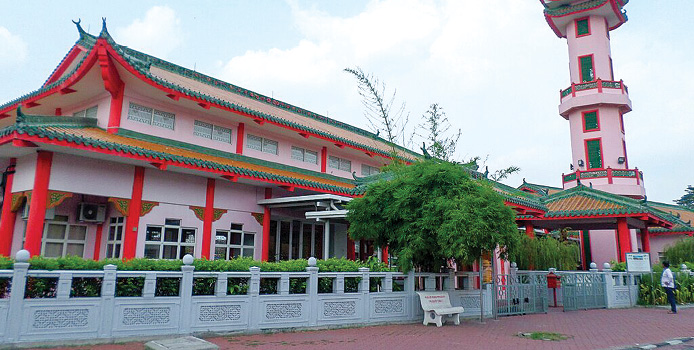
The Muhammadiah Mosque in Ipoh, completed in 2013, stands on the site of the Madrasah Muhammadiah, which was founded in 1973 by the late Haji Abdul Latif Mohd Kassim and his seven companions.
Built at a cost of RM4 million, the mosque is a striking symbol of cultural harmony. Its architecture blends Chinese and local design elements with Chinese-style arches, towers, and intricate dragon carvings.
The roof features a motif of Malaysia’s national flower, the hibiscus, replacing the traditional peony. The mosque’s geometric layout and its red, white, and green colour scheme, popular in Chinese culture, reflect Malaysia’s multicultural spirit while staying true to Islamic values.
Masjid Al-Khairiah
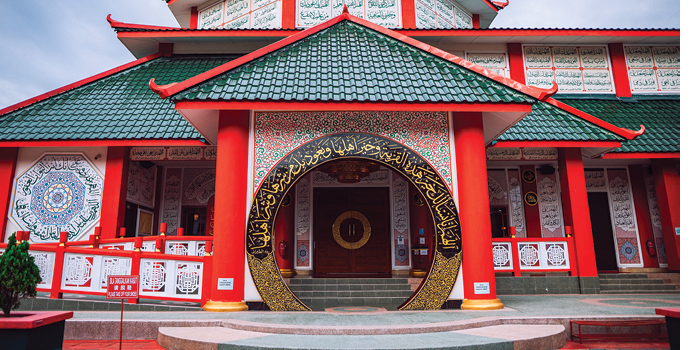
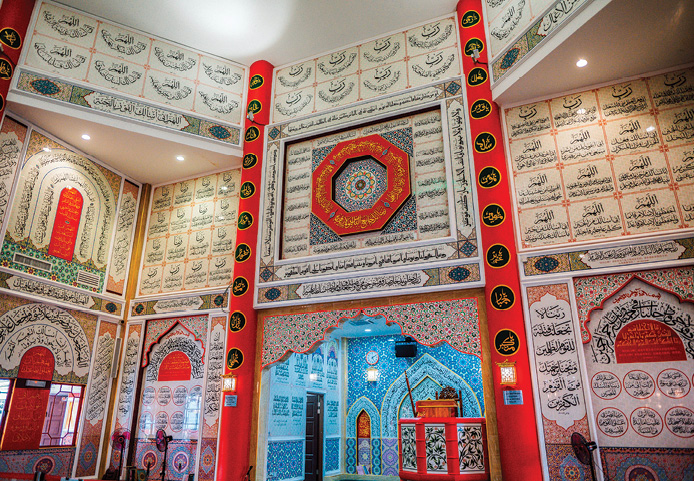
Masjid Al-Khairiah in Pulau Pangkor, also known as Masjid 1000 Doa, was completed in 2017 and officially opened on 19 June 2020. This distinctive mosque is renowned for its Chinese architectural style and is the only mosque adorned with prayers derived from the Quran and Hadith.
Its origins date back almost a century to when Chinese Muslims from the Kwangtung region first settled here, and a well from that period remains intact to this day. With an estimated construction cost of RM7 million, the mosque covers an area of 7,450 square feet, providing space for 500 worshippers.
Masjid Al-Khairiah stands as a testament to Malaysia’s rich cultural and religious diversity, symbolising the harmonious coexistence of its diverse communities.
Masjid Cina Al-Muttaqin
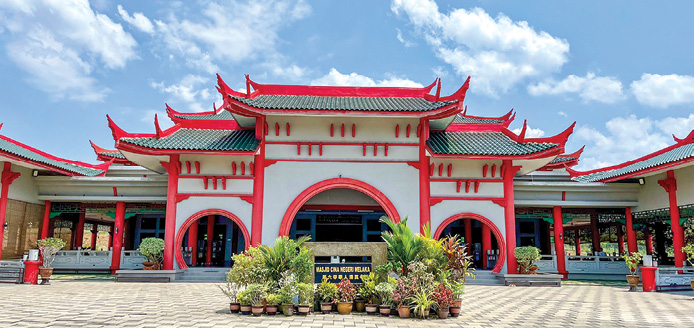
Masjid Cina Al-Muttaqin, also referred to as Masjid Cina Negeri Melaka, is a stunning representation of cultural integration. Constructed on 0.4 hectares of a 2.4-hectare site at a cost of RM7.5 million, the mosque’s construction commenced in October 2012 and was completed on 27 June 2014.
Its vibrant red exterior, reminiscent of a Chinese imperial palace, has made it a prominent attraction for both local and international visitors. While its design may initially resemble that of a Chinese Buddhist temple, distinguishing features affirm its identity as a mosque.
The architecture reflects cultural traditions, closely resembling mosques in China. This incorporation of Chinese architectural elements is deeply rooted in Melaka’s history, where Chinese design influences have been a part of the region’s heritage for centuries.
Masjid Jamek Cina Muslim
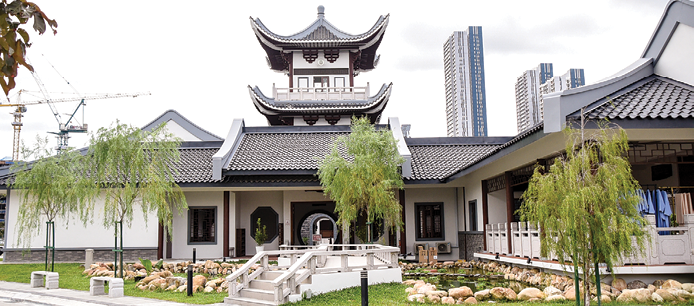
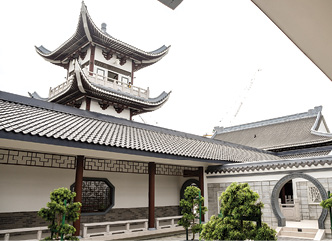
Masjid Jamek Cina Muslim, located in Bandar Botanik Klang, integrates Chinese cultural elements and draws architectural inspiration from the Grand Mosque of Xi’an in Shaanxi, China.
Built on 2.98 acres of land owned by the Selangor Islamic Religious Department, the mosque reflects key aspects of the Xi’an Mosque’s historic 1,282-year-old design, such as the layout of the main entrance leading to a central courtyard adjacent to the prayer hall.
However, certain features have been adapted to suit Malaysia’s climate, local regulations, and project constraints. Upon entering the mosque, visitors are greeted by an 18-metre tall tower called the Menara Cahaya Bulan (Moonlight Tower), topped with a unique ‘hip roof,’ differing from the pagoda-style tower of the Xi’an Mosque.
The prayer hall, which accommodates 450 jemaah as part of the mosque’s 1,000-person capacity, showcases elements like a wooden minbar, walls, and grand columns.